Verified Demantoid dealers & buying guide
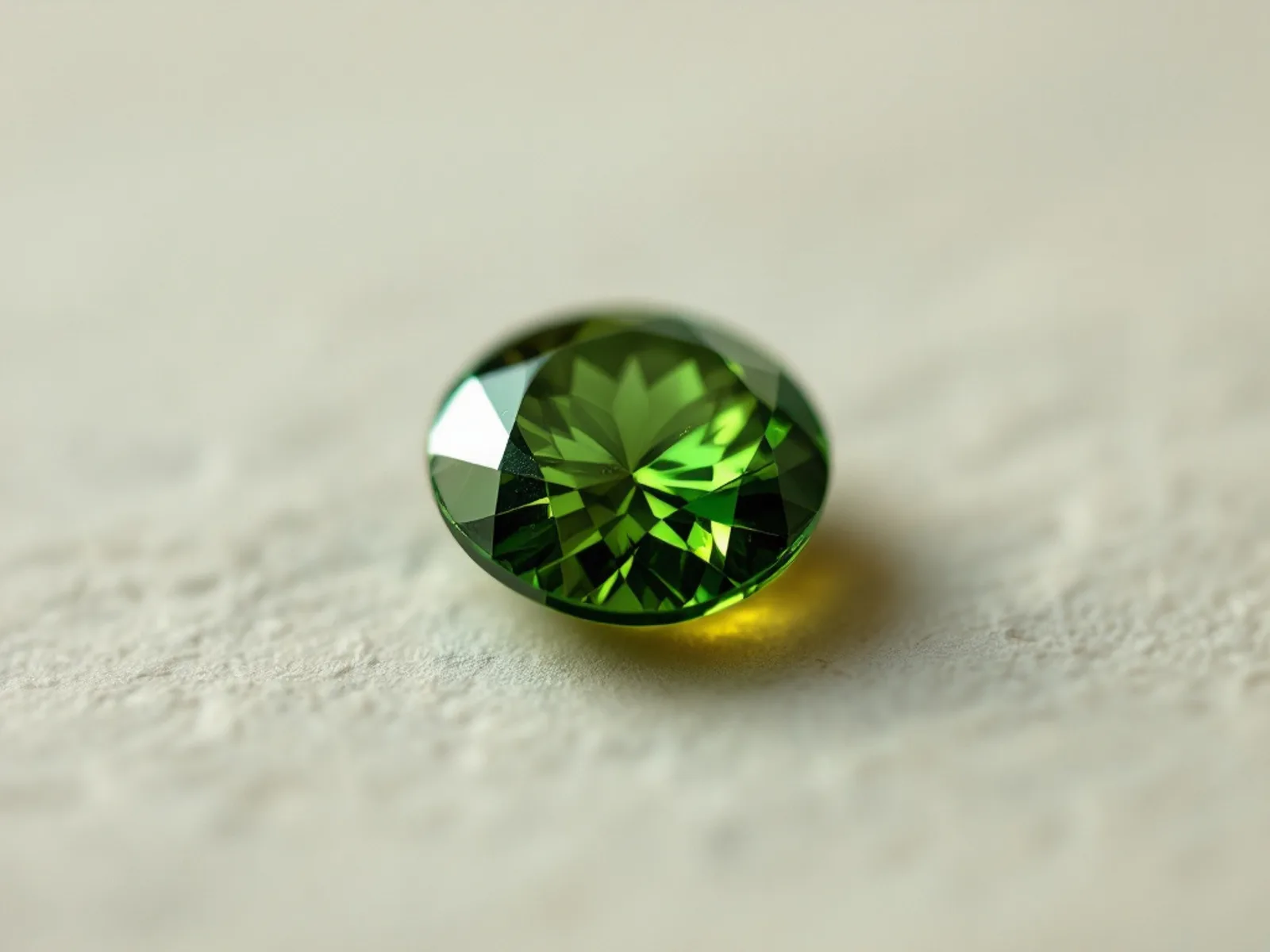
Demantoid is the green variety of andradite garnet. It is prized for its fire, a dispersion higher than diamond's. Russian stones are also prized for "horsetail" inclusions, fine fibres that collectors treat as a signature. Russia, Namibia and Madagascar are the sources that matter. Heat is used on some Russian material and should be disclosed. This page covers colour and inclusions, and the origins. It explains treatment, what laboratories report, what moves price, and how to buy.
Colour, fire and the horsetail
Andradite is calcium iron silicate, and demantoid is coloured green by chromium and iron. The name comes from the Dutch for diamond-like, on account of the fire. Demantoid splits light more strongly than diamond. A lighter-toned stone shows spectral flashes; a very saturated one can mask them. The trade grades colour from yellowish green through pure green to a bluish "emerald" green. Chromium-rich stones from Russia are the reference for deep green. Stones from Namibia and Madagascar tend to a yellower green with more visible fire. Very dark stones lose fire and are marked down.
The horsetail is a fan or spray of fine golden fibres of chrysotile, spreading from a central point. It formed as the garnet grew in serpentine rock. Horsetails are typical of Ural stones and of a few other deposits in serpentine. A well-placed horsetail raises price rather than lowering it. That is the reverse of the usual rule on inclusions. Stones from Namibia and Madagascar generally lack horsetails and are cleaner.
Where demantoid comes from
Demantoid was found in the Ural Mountains of Russia in the 1850s (Bobrovka River, later Poldnevaya and Karkodino). It was in vogue in Fabergé and Edwardian jewellery. Russian output is small and patchy, and it remains the top of the market. Namibia (Erongo region, the Green Dragon mine) began producing in the 1990s. It is the main modern source: clean, yellow-green to green, sometimes larger. Madagascar (Antetezambato, near Ambanja) produced a flush of material from 2009. It is green to yellowish green, with occasional larger stones. Italy (Val Malenco), Iran (Kerman) and Pakistan produce smaller amounts. Iranian stones can carry horsetails and are sometimes confused with Russian.
Origin affects price strongly for demantoid. Russian stones sell for a premium over African stones of similar appearance. Gübelin, SSEF, GIA, AIGS and GRS give origin opinions based on inclusions and trace elements. Because horsetails occur outside Russia, a horsetail alone does not prove Russian origin. The report does. An origin opinion is the laboratory's considered view, not a guarantee.
Heat treatment and disclosure
Some demantoid, mainly Russian, is heated at low temperature to reduce brown and improve the green. The treatment is stable. Since the mid-2000s it has been detectable in many cases. Laboratories look at changes in the iron chemistry and, in some stones, in the inclusions. Reports from Gübelin, SSEF and GIA state "no indications of heating" or "indications of heating" for demantoid. Unheated Russian stones command a premium. Demantoid from Namibia and Madagascar is generally sold untreated. No other treatment is common. Glass and synthetic garnets are rare in this colour. Green tourmaline, peridot and tsavorite are sometimes sold as demantoid. The fire of the real thing usually gives it away to a trained eye.
What laboratories report
A report should state species andradite, variety demantoid, natural, treatment (heat or none) and, if asked, origin opinion. For Russian stones, ask for a report that gives both origin and heat status. Use a laboratory that tests demantoid often: Gübelin, SSEF, GIA, AIGS or GRS. Two laboratories can differ on origin. Check that weight and dimensions match the stone. Origin and heat status come from that report, not from the seller alone.
What drives price and how to buy
- Colour: rich green with a hint of blue and no brown at the top; yellow-green lower.
- Fire: visible flashes in a stone that is not too dark.
- Origin: Russian at a premium, above all with a good horsetail.
- Treatment: unheated Russian stones over heated.
- Size: demantoid is small. Clean stones over one carat are uncommon, over two carats scarce, and over five carats rare.
- Clarity: apart from horsetails, eye-clean is preferred.
Ranges vary widely by origin, size and heat status. Small Namibian stones and large Russian stones are different markets.
How to buy
Ask the dealer for the origin as they know it. Ask whether a laboratory has confirmed it. Ask whether the stone has been heated. Ask to see the horsetail under a lens if one is claimed. Judge the stone in daylight and under a spotlight to see the fire. Demantoid is soft for a garnet (Mohs 6.5 to 7) and suits earrings and pendants better than daily-wear rings. Ask about the setting if you intend a ring.
Watch for:
- Stones from Namibia or Madagascar sold as Russian.
- Heated stones sold as unheated.
- Horsetails claimed on the strength of a photograph.
- Yellowish stones described as "top green".
Buying through the register
The dealers on this page have had legitimacy, certification practice and disclosure checked by GemsVerified. Ask for the laboratory report. Ask that origin and heat status be written on the invoice as reported, and keep report and invoice together.
GemsVerified verifies dealers, not individual stones. The report is the record for the stone.
Verified dealers
View all in directory →No dealers are currently admitted for this page. The catalogue grows as dealers pass verification.
Questions, answered
A spray of fine golden chrysotile (asbestos-group) fibres radiating from a point, formed as the garnet grew in serpentinite. Horsetails are typical of Russian Ural demantoid and are one of the few inclusions that raise a stone's price. They also occur in Iranian and some other serpentine-hosted material, so a horsetail alone does not prove Russian origin; a laboratory origin opinion does.
Some is, mainly Russian material, heated at low temperature to reduce brown and improve the green. Demantoid from Namibia and Madagascar is generally sold untreated. Laboratories such as Gübelin, SSEF and GIA can often detect heating in demantoid and state "indications of heating" or "no indications of heating" on the report. Unheated Russian stones carry a premium, so ask for the report rather than the seller's assurance.
Russia's Ural Mountains, the historic and most valued source, with small irregular production. Namibia (Erongo) is the main modern commercial source and Madagascar (Antetezambato) produced significant material from 2009. Italy, Iran and Pakistan supply smaller amounts. Origin affects price strongly and should be confirmed by a laboratory origin opinion for any stone sold as Russian.
Russian stones tend to have the most saturated chromium green, often carry the horsetail inclusions collectors want, and are scarce because production is small and irregular. Historic association with Fabergé and Edwardian jewellery adds to demand. Namibian and Madagascan stones of similar appearance sell for less, which is why origin should be confirmed on a laboratory report.
For any stone sold as Russian, or as unheated, or above about a carat, yes. Ask for a report from an independent laboratory that routinely tests demantoid, such as Gübelin, SSEF, GIA, AIGS or GRS, stating natural andradite garnet (demantoid), heat status and origin opinion. Small commercial Namibian stones are often sold on a dealer's invoice alone.